
How to Draft an RTI Application So Effectively That Rejection Becomes Difficult
Every day, thousands of RTI applications are filed with the hope that the applicant will finally get the desired information. No one randomly wakes up one morning and starts asking questions from a government office for no reason. Behind most RTIs, there is usually a problem.
Maybe someone’s work is stuck.
Maybe a pension has not been released.
Maybe a recruitment process appears doubtful.
Maybe a complaint is being ignored.
Or maybe a citizen simply wants to know what action has been taken on their application.
At the end of the day, government departments exist to provide services and discharge public functions. And when people do not get answers through ordinary channels, many turn towards the RTI Act.
When aggrieved by a government office, people file RTIs to obtain information so that they can decide their next course of action. Because in reality, one can fight for their rights properly only when there is some material in hand. RTI acts as a bridge to collect that material.
And this is where the biggest fear arises in the mind of an RTI applicant:
"Will I actually get the information, or will my RTI be rejected?"
The truth is that many RTI applications are rejected not because the information cannot legally be given, but because the RTI itself is drafted in the wrong manner.
If you want to make your RTI application difficult to reject, then you need to understand one very important thing — Section 2(f) of the RTI Act, 2005.
Understanding Section 2(f)
Section 2(f) defines the word "information." In simple language, it tells us what can actually be asked under the RTI Act.
This is where many applicants unknowingly make mistakes.
People often draft RTIs in the form of:
- Why was my work not done?
- Why was action not taken?
- Explain the reasons behind this decision.
- Justify why this happened.
But the RTI Act is not meant for seeking explanations, opinions, clarifications, or justifications from the PIO. The Act mainly gives citizens the right to access information that already exists on government records.
And this is the golden formula that can make a huge difference while drafting an RTI application.
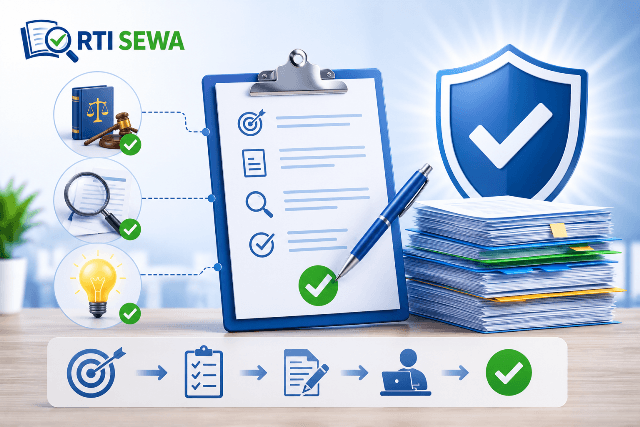
The Golden Formula
Ask for:
- Copies
- Records
- File notings
- Circulars
- Emails
- Reports
- Inspection records
- Certified extracts
- Rules relied upon
- Action taken records
- Correspondence available on file
Avoid asking:
- Why
- Explain
- Justify
- Clarify
- Opinion
- Interpretation
The more your RTI asks for existing records instead of explanations, the stronger your application becomes.
Practical Examples
Example 1: Pension Matter
❌ Weak RTI
Why was my pension delayed?
✅ Better RTI
Provide certified copies of file notings, correspondence, and action taken records relating to my pension application dated __.
Example 2: Recruitment Matter
❌ Weak RTI
Why was Candidate X selected over me?
✅ Better RTI
Provide copies of the selection criteria, marks awarded to selected candidates, and file notings related to the recruitment process.
See the difference?
The second type of RTI asks for records that are expected to exist. It remains within the framework of Section 2(f).
Understanding the Limits of a PIO
One important thing that RTI applicants should understand is that PIOs and government officials are themselves bound by rules, regulations, circulars, and the RTI Act. They cannot travel beyond what the law permits them to provide.
In a way, the law has drawn a kind of "Laxman Rekha" for the CPIO.
They cannot create information that does not exist.
They cannot give personal opinions.
They cannot justify administrative decisions unless such justification already exists on record.
So instead of drafting an RTI outside that boundary, it is always wiser to draft it within that legal framework itself.
Final Takeaway
Many times, the strength of an RTI application does not lie in aggressive language. Its strength lies in asking for the right thing, in the right manner.
An RTI becomes difficult to reject when it is aligned with the language of the Act itself.
So the next time you draft an RTI application, remember this simple rule:
Ask for records, not reasons. Ask for documents, not explanations. Ask for information that exists, not opinions that need to be created.
That single shift can dramatically improve your chances of getting the information you seek.