Introduction
If you’re using the RTI Act for the first time, one question matters more than anything else: what exactly can you ask for?
Many RTI applications fail not because the issue is weak, but because the request does not fit the legal meaning of information under RTI.
The Right to Information Act, 2005 is a powerful law. But it works within clear boundaries. If you understand what counts as “information,” you can draft a valid RTI application that actually gets results.
Let’s break this down in the simplest way possible.
What is Section 2(f) of RTI Act?
The term “information” is defined in Section 2(f) of the RTI Act 2005. This section tells us what you are legally allowed to ask from a public authority.
In simple terms, information under RTI means any material that already exists in recorded form with a government department or public authority.
This could be:
- A file in an office
- A report prepared by officials
- An email sent between departments
- A register or database entry
👉 The most important idea to remember is this:
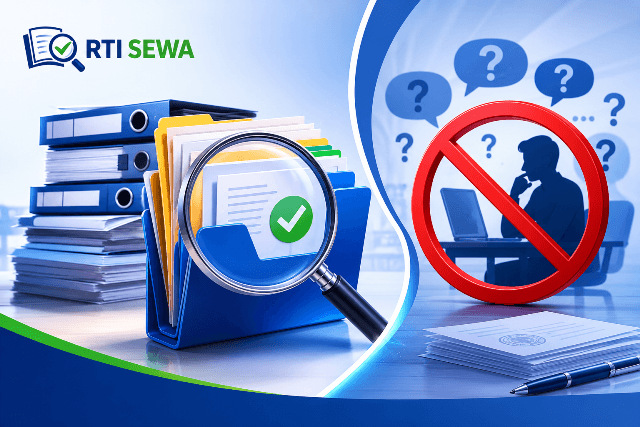
RTI is about accessing existing records — not asking questions or seeking explanations.
A public authority is required to:
- Provide copies of records that already exist
- Share documents, data, and files available with them
But it is not required to:
- Create new information
- Answer “why” something was done
- Give explanations, opinions, or justifications
Once you understand this one principle, everything about Section 2(f) RTI becomes much clearer.
What Counts as Information under RTI?
Now let’s look at what actually qualifies as information under RTI Act.
Think of anything that is written, stored, or recorded in some form.
Here are common RTI information examples:
- Documents, files, and file notings
- Office orders, circulars, and notifications
- Emails, letters, and official memos
- Reports, inspection notes, and enquiry findings
- Registers, logbooks, and attendance records
- Contracts, agreements, and tender documents
- Data stored electronically (PDFs, Excel sheets, databases)
- Audio/video records (if maintained officially)
👉 Another important point:
Information can also include material related to private bodies, but only if that information is accessible to a public authority under any law.
For example:
- A private school submitting records to the education department
- A contractor submitting reports to a municipal authority
In such cases, you can request those records through the government authority.
What Does NOT Count as Information?
This is where most RTI applications go wrong.
The RTI Act does not allow you to ask for:
- Questions starting with “why”
- Explanations or reasoning
- Opinions or interpretations
- Hypothetical or future decisions
- Requests to create or compile new data
Examples of invalid RTI requests:
- “Why was my application rejected?”
- “Explain why the road has not been repaired.”
- “Justify the delay in processing my file.”
- “What action will you take in future?”
👉 Why are these invalid?
Because they are questions, not requests for existing records.
Under Section 2(f) RTI, the authority can only give you:
- What is already written or recorded
- Not what is in someone’s mind
If the answer is not already documented somewhere, the authority is not required to create it for you.
Real-Life Examples of RTI “Information”
Let’s make this practical. Here are examples of valid RTI points that fall within information under RTI:
-
“Provide copy of file noting regarding sanction of XYZ scheme.”
✔ Valid because it asks for an existing file record. -
“Provide copies of inspection reports conducted on 15 January 2026 at ABC Hospital.”
✔ Valid because inspection reports are official records. -
“Provide certified copy of the contract signed with M/s ABC Constructions for road project in Ward No. 10.”
✔ Valid because contracts are documented agreements. -
“Provide details of entries in the complaint register for drainage issues in XYZ area between January and March 2026.”
✔ Valid because registers are maintained records. -
“Provide copies of emails exchanged between the municipal office and contractor regarding project delay.”
✔ Valid because emails are part of official communication records.
👉 Notice the pattern:
Each request clearly asks for a specific, existing record.
That is the essence of a valid RTI application.
How Courts View ‘Information’ (CBSE Case in Simple Words)
The Supreme Court has clarified the meaning of information under RTI in an important case: CBSE v. Aditya Bandopadhyay.
In very simple terms, the Court said:
- A public authority must provide existing records
- It is not required to create new answers
- It does not have to analyze, interpret, or explain
👉 What does this mean for you?
When you file an RTI:
- Think like you are asking for documents, not answers
- Focus on what exists in files, not what you want explained
This approach makes your RTI stronger and more likely to succeed.
Common Mistakes First-Time RTI Users Make
If your RTI gets rejected, it is often due to simple mistakes. Here are the most common ones:
1. Asking “why” instead of asking for records
❌ Wrong: “Why was my pension delayed?”
✔ Fix: Ask for file noting or status reports
2. Writing vague or overly broad requests
❌ “Provide all details about the department.”
✔ Fix: Specify subject, time period, or document type
3. Mixing RTI with complaints or grievances
❌ “Take action against the officer.”
✔ Fix: Ask for complaint records or action taken reports
4. Not identifying specific records
❌ “Give information about road work.”
✔ Fix: Mention location, project name, or dates
5. Asking for future decisions
❌ “What steps will be taken?”
✔ Fix: Ask for existing plans, proposals, or records
6. Expecting explanations or justifications
❌ “Explain why this decision was made.”
✔ Fix: Ask for documents that show the decision-making process
7. Using unclear language
❌ “Give complete information.”
✔ Fix: Clearly state what record you want
Quick Drafting Tips to Stay Within Section 2(f)
If you remember nothing else, remember this:
Always frame your RTI around records and documents.
Start with:
- “Provide copy of…”
- “Provide certified copy of…”
- “Provide details of records relating to…”
Mention:
- Dates
- Locations
- File numbers (if known)
- Project names
Avoid:
- “Why”, “Explain”, “Justify”
Examples:
❌ Why was my road not repaired?
✅ Provide copy of file noting regarding repair of XYZ road.
✅ Provide copies of status reports of road repair project for XYZ road between [date] and [date].
👉 The ❌ example is outside Section 2(f) RTI because it asks for a reason.
👉 The ✅ examples are valid because they ask for existing records.
How a Validator Tool Can Help You Draft Better RTIs
If you are new to RTI, it can be hard to know whether your request fits the law.
This is where a tool like an RTI Validator can help.
Think of it as a smart assistant that checks your draft before you submit it.
It can help by:
-
Detecting words like:
- “why”
- “explain”
- “justify”
These usually indicate invalid questions
-
Identifying vague phrases like:
- “all information about”
- “details about everything”
These often lead to rejection
-
Checking whether your request:
- Refers to a specific record
- Mentions a time period or subject
- Is clear and focused
👉 The goal is simple:
Train yourself to think in terms of documents, files, and records, not questions.
A validator tool can guide you in that direction.
Conclusion – Think in Terms of Records, Not Questions
At its core, the RTI Act is about access to existing information, not explanations.
Under Section 2(f), information under RTI means:
- Something that is already recorded
- Something that exists in files, documents, or databases
If you frame your RTI around:
- File notings
- Reports
- Contracts
- Registers
…you are far more likely to receive a meaningful reply.
The moment you shift from asking “Why?” to asking “Provide records…”, your RTI becomes stronger.
Use this understanding wisely.
Ask clearly. Ask precisely.
And make full use of your right to information — responsibly and effectively.