Every year, lakhs of RTI applications are filed across the country to seek information from Government departments and public authorities. As per the annual report of the Central Information Commission for the year 2024-25, around 18 lakh RTI applications were filed in the year 2024–25 alone.
But here's the real question — do people always get the information they are actually looking for?
In many cases, the answer is no.
And surprisingly, the problem is not always secrecy or unwillingness of the department. Sometimes, the RTI application itself is drafted in a way that makes it legally weak from the very beginning.
One sentence can decide whether your RTI succeeds or dies.
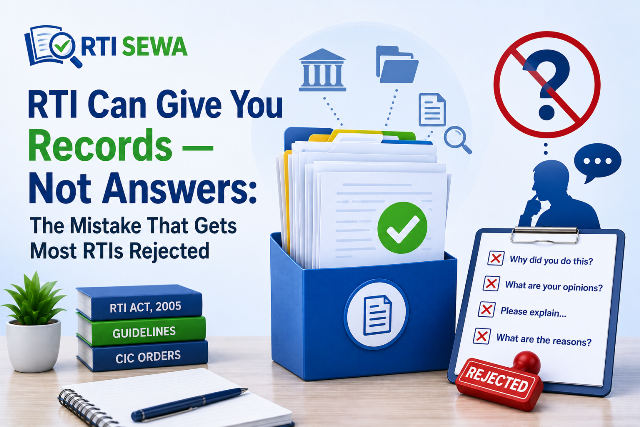
Most people unknowingly make one common mistake while drafting RTI applications. They ask questions instead of asking for records.
Questions like:
- ➤ Why was my file delayed?
- ➤ Who is responsible for this?
- ➤ Why was this decision taken?
- ➤ Please explain the reason...
These may sound perfectly reasonable in normal conversation, but under the RTI Act, such questions often become problematic.
Why Does This Happen?
Because the RTI Act gives you the right to access information, not to demand explanations or justifications from the CPIO.
To understand this properly, we need to look at one of the most important provisions of the RTI Act — Section 2(f).
What Does Section 2(f) Say?
Section 2(f) defines "information" as:
Any material in any form, including records, documents, memos, e-mails, opinions, advices, press releases, circulars, orders, logbooks, contracts, reports, papers, samples, models, data material held in any electronic form...
In simple words, RTI gives you access to information that already exists with the public authority in some recorded form — whether in files, registers, documents, emails, or computer records.
The keyword here is:
Already exists.
The CPIO is expected to provide records available with the department. The RTI Act does not require the CPIO to:
- ▹ Create fresh answers
- ▹ Give personal opinions
- ▹ Make interpretations
- ▹ Explain reasons
- ▹ Reply to hypothetical questions
This is where many RTIs fail.
A Real-Life Example
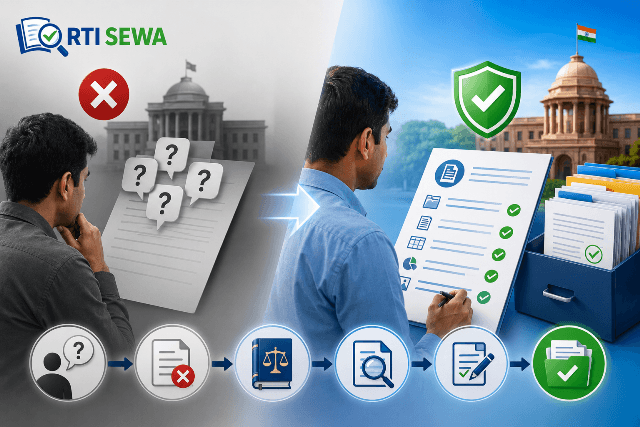
❌ Weak RTI Query
Why was my pension delayed?
At first glance, it looks like a valid question. But legally, this asks the department to explain and justify something.
✅ Strong RTI Query
Provide copies of file notings, movement register entries, and correspondence related to processing of my pension application dated ___.
See the difference?
In the second query, you are not asking the CPIO to explain anything. You are asking for records that already exist in official files.
Once you receive those records, you can yourself understand where the delay happened and who handled the matter.
That is the real power of a properly drafted RTI.
📚 Also Read
Another Example
✅ Valid RTI
Please provide a copy of the tender document published on [date].
This seeks an existing document.
❌ Weak RTI
Whether the department is planning to publish the tender on [date]?
This seeks clarification or future intention, which may not exist as recorded information.
The Fridge Analogy
A very simple way to understand RTI is this:
Think of RTI as opening a fridge.
You can only take out what is already stored inside it.
You cannot expect the fridge to first cook the food, prepare it, refrigerate it, and then serve it to you.
Similarly, under RTI, the CPIO is expected to provide existing material available in records. The CPIO is not expected to create answers or conduct analysis for you.
The Shift That Changes Everything
Many people assume that their RTI was rejected because the department wanted to hide information. Sometimes that may be true. But many times, the real issue lies in the wording of the application itself.
A Badly Framed RTI Asks:
- ▹ Why?
- ▹ How?
- ▹ Who is responsible?
A Well-Drafted RTI Asks:
- ▹ Provide copies of...
- ▹ Provide certified records relating to...
- ▹ Provide file notings and correspondence regarding...
That small shift changes everything.
Before You File Your RTI
Ask yourself one simple question:
Am I asking the CPIO to answer me, or am I asking the CPIO to provide records?
If your query seeks something already available in files or electronic records, your RTI becomes much stronger.
Ultimately, the success of an RTI often depends less on intention and more on drafting.
Because under the RTI Act, the CPIO is not supposed to cook the food for you.
But if the food already exists in the fridge, you absolutely have the right to ask for it.